Parking a rental car in Guam is usually straightforward once you know what to check. The painted space is only part of the picture: signs, curbs, entrances, fire hydrants, and the direction of traffic all matter. This guide explains Guam parking rules in practical terms for hotels, shopping centers, attractions, beaches, and the limited places where curbside parking is permitted.
Guam parking essentials
- In a marked lot, place the entire vehicle inside the white lines.
- Check entrance signs for hours, permits, fees, validation, and tow-away rules.
- When curb parking is legal, park with traffic at the right-hand curb.
- Keep both an accessible space and its striped access aisle clear.
- Turn off the engine, take the key or key fob, set the parking brake, and lock the vehicle.
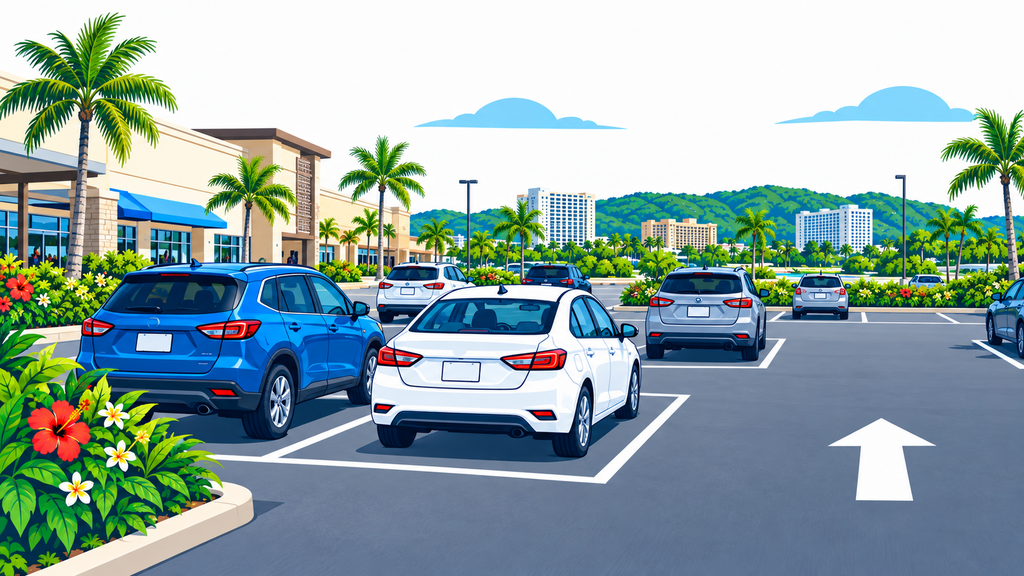
Mall and hotel parking is not automatically free
Many Guam shopping centers provide customer parking, and some lots are free. That does not mean every facility is free at all times. Conditions may change after business hours, during events, for long stays, or when a hotel lot is used by a non-guest. Read the signs at the entrance and payment equipment. At hotel check-in, ask whether you must register the vehicle, display a permit, or pay for valet service.
If regular spaces are full, do not improvise in a driving aisle, loading area, fire lane, or landscaped shoulder. Posted property rules and staff directions apply within private lots.
Curbside parking: stay with traffic at the right curb
Guam drives on the right. Where curbside parking is allowed, Guam law generally requires the vehicle’s right-hand wheels to be parallel to and within 18 inches (about 46 cm) of the right-hand curb. In plain terms, pull over on the right without turning across the road to park facing oncoming traffic. Where spaces are marked, keep the whole vehicle within the designated lines.
Do not assume that a road is legal or safe for parking just because there is no sign beside your car. Outside a business or residential district, a vehicle generally must be placed off the main traveled portion when that is practicable. If it is left on a highway, at least 15 feet (about 4.6 m) of clear roadway must remain opposite the vehicle and the vehicle must be visible from 300 feet (about 91 m) in both directions. If you cannot confidently judge those conditions, use a formal parking lot.
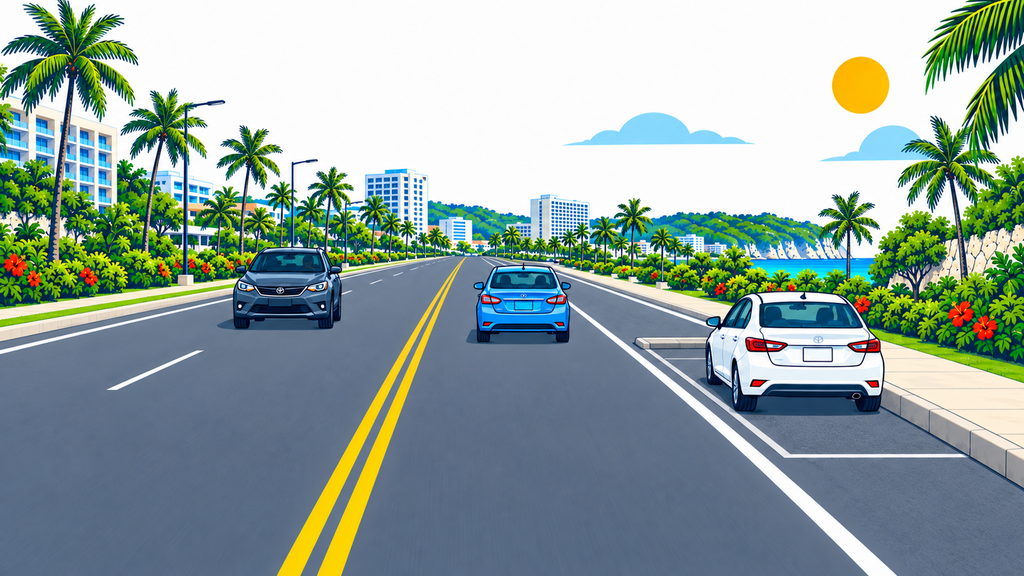
Places where parking is prohibited
On a public highway, do not stop or park in the following locations, even for a short wait:
- Inside an intersection, on a crosswalk, or on a sidewalk
- In front of a private driveway or parking-lot entrance
- Within 15 feet (about 4.6 m) of a fire hydrant
- Within 15 feet (about 4.6 m) of a fire-station driveway
- Within 25 feet (about 7.6 m) of intersection curb lines; a different 15-foot reference applies where there are no curb lines
- Within 30 feet (about 9.1 m) on the approach side of a roadside flashing signal, stop sign, or traffic signal
- Beside or opposite roadwork or an obstruction when adequate passage cannot remain open
- On the roadway side of a vehicle already parked at the curb—commonly called double parking
Also obey official NO PARKING, NO STOPPING, and TOW AWAY signs. Curb-color practices may depend on the facility or zone, so do not rely on color alone; read the nearby sign and pavement markings together.
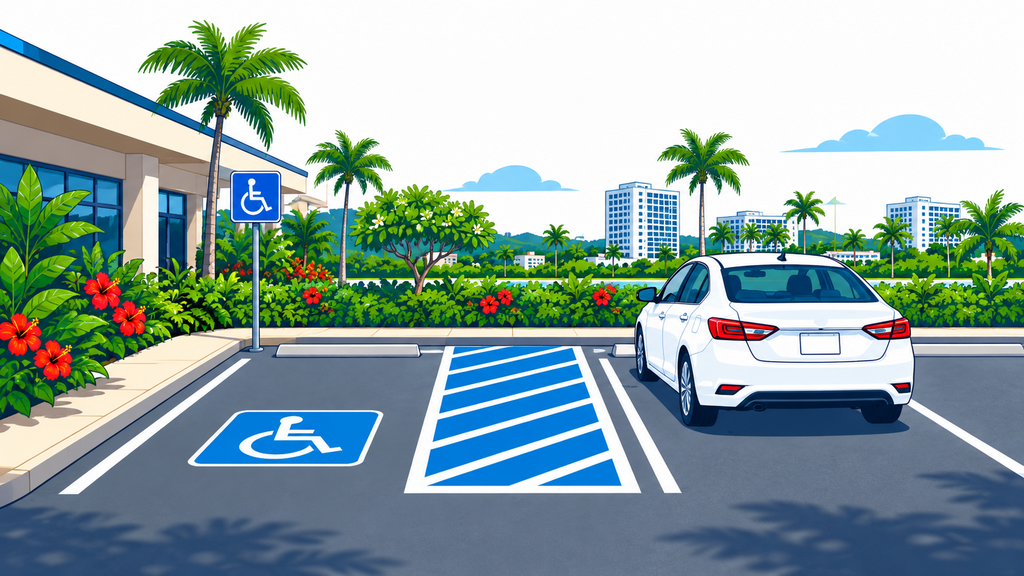
Keep accessible spaces and access aisles open
An accessible space displaying the wheelchair symbol is reserved for a vehicle with a valid qualifying plate or placard. The striped area beside it is not an extra parking space: it is an access aisle for a wheelchair, ramp, or lift. Do not stop there to load passengers, place luggage, or let part of the vehicle extend over the stripes. Visitors wishing to use a permit issued outside Guam should confirm its acceptance with the issuing authority or the appropriate Guam agency rather than assume reciprocity.
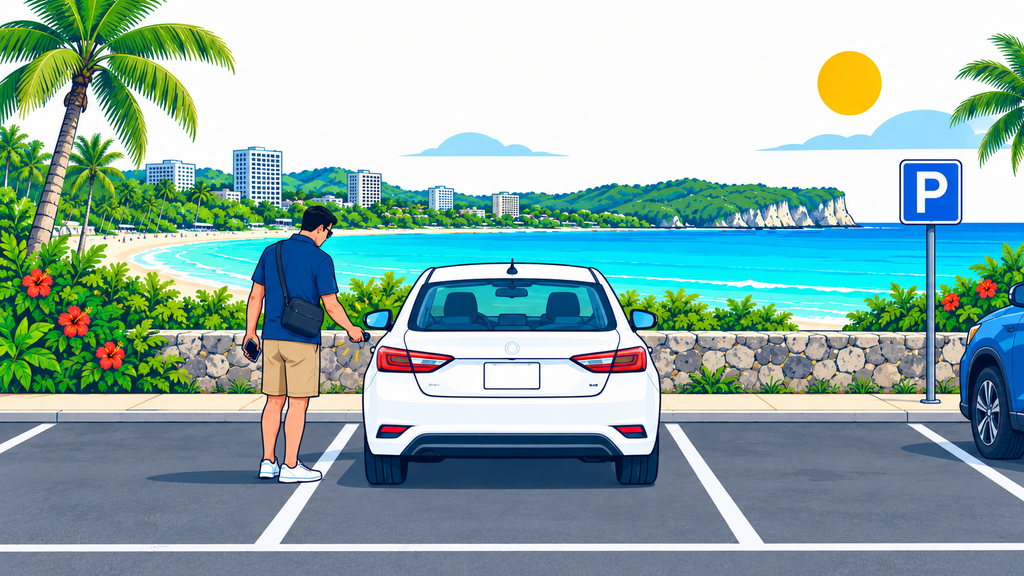
At attractions and beaches, use designated parking
At parks, overlooks, and beaches, use a paved marked space or an area identified for parking. Guam law generally prohibits driving, stopping, or parking a vehicle on the beach below the high-water mark, with narrow exceptions such as launching or retrieving a boat. Do not drive onto the sand. Along the road, avoid any place that blocks traffic, access, or visibility.
A simple vehicle-security routine
Even for a brief stop, do not leave passports, wallets, phones, cameras, or shopping bags visible on a seat. Take valuables with you whenever possible. If something must go in the cargo area, avoid rearranging it conspicuously after arriving at an isolated destination. Choose a well-lit, active area, close every window, and confirm that every door is locked. Keep any key tag showing the rental-car details with you, not in the car.
Extra checks in rain, on hills, and at night
- Heavy rain: Avoid low spots with standing water. If lines are difficult to see, check the vehicle’s position after getting out.
- On a grade: Set the parking brake firmly and turn the front wheels toward the curb or side of the road.
- At night: Choose a well-lit area with a safe walking route to the entrance.
- When backing out: Look directly for pedestrians and vehicles before moving; reverse slowly when visibility is limited.
Frequently asked questions
Is parking free at every Guam shopping mall?
No single rule applies to every property. A facility may offer free customer parking while setting limits for business hours, events, or long stays. Check the current signs on site.
Does a yellow curb always mean no parking?
Do not make the decision from curb color alone. Read the posted sign, pavement markings, and property instructions. You may not park where an official sign restricts stopping or parking.
What should I do if a rental car is moved or towed?
Photograph the parking signs and surroundings, then contact the rental company. On private property, also ask the property manager or security staff. Do not remove a wheel device or move another vehicle yourself.
Summary
Five habits make parking in Guam much easier: stay within the marked space, read local signs, keep the required distance from prohibited areas, leave accessible spaces and access aisles clear, and remove valuables from view. If curbside parking feels uncertain, choose an authorized hotel or facility lot.
Legal information is based on 16 GCA Chapter 3, Article 4 (Parking), checked in September 2026. Current signs, property rules, and police directions take priority.

