Guam uses U.S.-style traffic rules. Day-to-day driving basics—which side of the road to use, how to use lanes—are covered in “The Complete Guide to Driving in Guam.” This article focuses on the mistakes visitors most often get cited for, and what to do if an officer signals you to stop or a crash occurs.
Six mistakes that commonly lead to a citation
- Right turn on red: a “rolling stop” without coming to a complete stop first is a violation.
- The yellow center lane: using it as a through lane or to pass is a violation—it’s for a brief left turn only.
- School buses: passing while children are loading or unloading is prohibited in both directions.
- Speed: signs are in mph; even a posted-or-under speed can still be cited depending on conditions.
- Phones: stopped at a light or in traffic still counts as “driving”—holding the phone is prohibited.
- Seat belts and child restraints: required for every seat, with the restraint type depending on the child’s age and height.
“The Complete Guide to Driving in Guam” covers the correct technique for each of these (how to use the center lane, the right-on-red procedure, and so on) in detail. Here, we focus only on the parts visitors most often overlook.
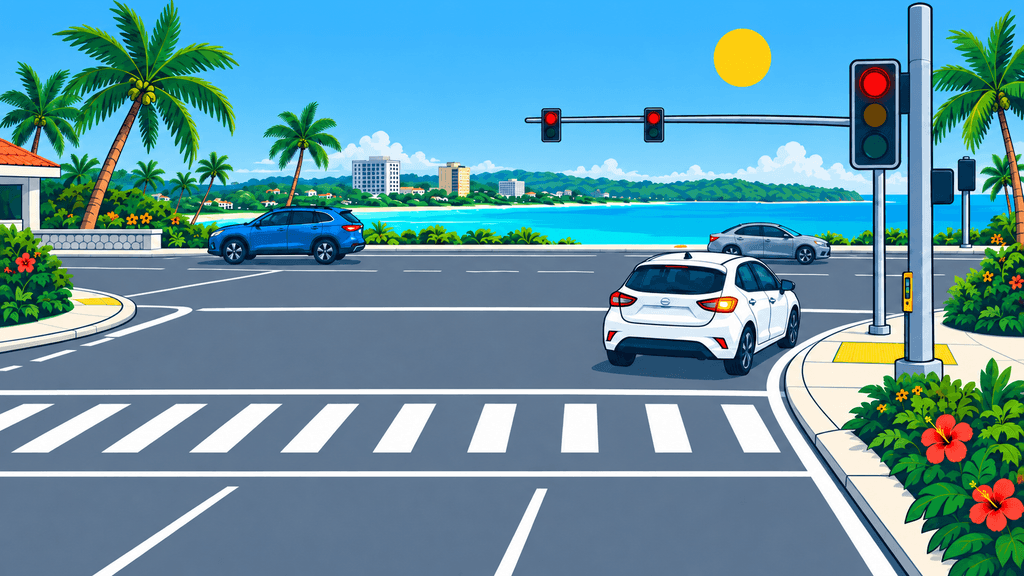
Do not treat the center lane as an all-purpose U-turn lane
An open-looking center lane is not automatic permission to enter—pavement arrows and signs control. It is also incorrect to treat every center lane as a U-turn lane. On a two-way street in a business or residential district, Guam law restricts U-turns: they must be made at least 100 feet from an intersection and only as official signs indicate.

Impaired driving, drinking in the vehicle, and open containers
It is illegal to drive or be in physical control of a vehicle while impaired in Guam. The per se alcohol threshold is 0.08% for a person age 21 or older and 0.04% for a person under 21. A reading below those figures is not a guarantee that driving is lawful or safe; impairment can still support an offense. If alcohol is part of the plan, arrange a sober driver or other transportation in advance.
Passengers as well as drivers may not drink alcohol while riding in a motor vehicle. Transporting or possessing an opened, unsealed, or partly consumed alcoholic beverage in a vehicle on a public highway is generally prohibited. The law provides an exception when it is secured in a trunk or rear compartment not normally occupied by or immediately accessible to the driver or passengers. A glove compartment does not qualify.

What to do when an officer signals you to stop
- Signal, avoid sudden movements, and pull into a well-lit, safe location on the right where you will not block traffic.
- Shift to Park and turn off the engine. At night, switching on the cabin light can help make the situation clear.
- Remain in the vehicle with your hands visible. Wait for instructions before reaching for documents.
- When asked, present your license and vehicle registration documents. Know where the rental agreement is stored as well.
If you receive a citation, read its deadline and instructions for payment or appearance. Do not assume the rental company will resolve it automatically. Under Guam’s Traffic Court Rules, repeat judgments within 12 months can trigger added amounts and possible license suspension.
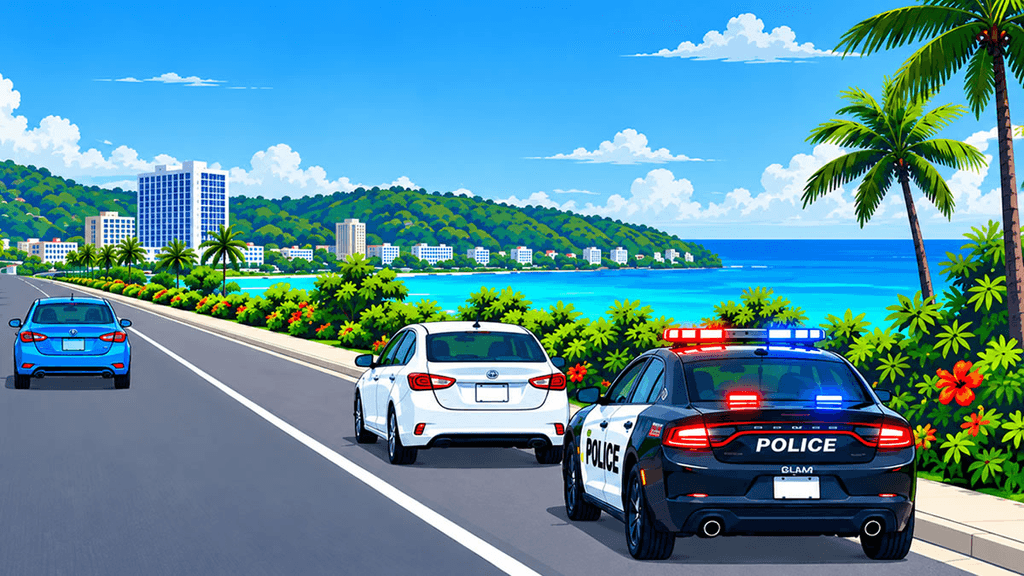
If a crash or minor contact occurs
- Stop and address immediate danger: Call 911 for injuries, fire, or an active traffic hazard. Otherwise, do not leave the scene and follow police instructions.
- Exchange required details: Confirm names, addresses, registration numbers, and driver’s licenses as required by law, and provide reasonable aid to anyone injured.
- Document the scene: Once safe, photograph vehicle positions, damage, road conditions, the other vehicle, and note the time. Do not decide fault on the spot or settle only with private cash.
- Call the rental company: Even for a minor scrape, promptly use the accident number in the rental agreement and follow instructions about moving, towing, replacement vehicles, and paperwork.
Guam law requires a driver involved in a crash causing injury, death, or property damage to stop immediately and exchange the required information. A written report is due to the Guam Police Department within 24 hours when there is injury or death, or apparent total property damage of $50 or more. Even small modern vehicle repairs can exceed that threshold, so confirm the process with police and your rental company rather than making your own determination. It is also too broad to say that insurance is always void without a police report; coverage depends on the rental contract, the facts, and completion of required procedures.
Frequently asked questions
Must I turn right on red when it is allowed?
No. Permission to turn is not an obligation. If you cannot confirm a safe gap, wait for green even if a driver behind you is impatient.
When may I wait in the yellow center lane?
Only where arrows or signs permit it and you are about to turn left. Think “main road into a store” or “store driveway onto the main road with a left turn.” Never use it as a normal through lane.
Can I simply hand a traffic ticket to the rental company?
Returning the car does not necessarily close the matter. Follow the court method and deadline printed on the citation, and ask the rental company whether it also requires notice.
In summary
To avoid the most common Guam violations: stop fully before turning right on red, never use a yellow center lane for through travel or U-turns, stop in both directions for a school bus loading or unloading, and never drive after drinking. Review “The Complete Guide to Driving in Guam” for the everyday basics, and if you are stopped by police or involved in a crash, follow the steps in this article calmly.
Legal details were checked in September 2026 against 16 GCA Chapter 3 (rules of the road and crashes), 16 GCA Chapter 26 (seat belts and child restraints), 9 GCA Chapter 92 (alcohol, drugs, and driving), and the Judiciary of Guam Traffic Court Rules. Follow on-site police directions, current signs and signals, current law, and your rental agreement.

